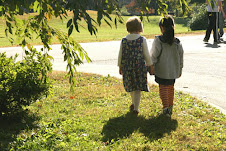
The general theme of this month's walk-and-talks is a look at the edges of a Sudbury-model population. We've looked at how the Sudbury model could be expanded to include even younger people (less than 4 years old), even older people (over 19 years old), and part-time students. This month, we'll look at how our school might connect with the larger Kingston community.
Sudbury-model schools each have some form of a policy dealing with students leaving campus during the school day. This open-campus policy might describe, for example, limits that depend on the student's age, what supervision is required, and when parental approval is required.
One advantage of a more-open policy is that students can take more advantage of Kingston's resources - people, places, things. Another advantage is that it means more freedom. Freedom is an abstract value that can have concrete consequences, one consequence being that students get more experience and skills in living with freedom.
One advantage of a more-closed policy is that it might be safer. Another advantage of being more closed is that students are more present on campus, possibly enriching the school.
We'll discuss these issues and anything else that comes up regarding our school's open-campus policy.
I personally won't be at this week's walk-and-talk, or the next few. I'm in England caring for my granny. If you'd like to discuss this topic with me when I'm back, please leave a comment below.
Sunday, July 25, 2010

Saturday, July 17, 2010
Including Part-time Students
The general theme of this month's walk-and-talks is a look at the edges of a Sudbury-model population. The last 2 weeks, we looked at how the age range of the Sudbury model could be expanded to include even younger people (less than 4 years old) and even older people (over 19 years old). At this Monday's walk-and-talk, we'll look at the question of including part-time students in the Sudbury model.
An advantage of offering a part-time option is that some people prefer the flexibility. Another advantage is that it makes the school affordable to more people. Perhaps these factors also enrich the school culture.
A disadvantage of offering a part-time option is that it reduces continuity, which might jar the school culture. Another disadvantage is that choosing a part-time option might indicate a family's lack of support for the Sudbury model (like being part-time vegetarian).
This walk-and-talk is an invitation to explore and weigh these factors, and consider any other factors related to a part-time option.
I personally won't be at this week's walk-and-talk, due to another commitment. If you'd like to discuss this topic with me, please leave a comment on this post.
An advantage of offering a part-time option is that some people prefer the flexibility. Another advantage is that it makes the school affordable to more people. Perhaps these factors also enrich the school culture.
A disadvantage of offering a part-time option is that it reduces continuity, which might jar the school culture. Another disadvantage is that choosing a part-time option might indicate a family's lack of support for the Sudbury model (like being part-time vegetarian).
This walk-and-talk is an invitation to explore and weigh these factors, and consider any other factors related to a part-time option.
I personally won't be at this week's walk-and-talk, due to another commitment. If you'd like to discuss this topic with me, please leave a comment on this post.
Sunday, July 11, 2010
Including Older People
The general theme of this month's walk-and-talks is a look at the edges of a Sudbury-model population. Last week we looked at how younger people (specifically 3-year-olds) might be included in the Sudbury model. At this Monday's walk-and-talk, we'll look at the question of including older people in the Sudbury model. Sudbury-model schools typically have students as old as 18 or 19.
Do our school's founding beliefs apply just as well to 20-year-olds? Let's look at each belief in turn:
Children have a drive to understand and master the world around them, to grow up: I see this as just as true of young adults who have been raised with this drive supported.
Each person has the best sense of how they learn best: Again, seems as true for young adults.
Most learning is an unintended consequence of following one's interests: Young adults may be more likely than kids to specialize in a particular area of study, with intentional learning. What impact would this have on how a school would be designed for them based on Sudbury values?
Behaviour is greatly influenced by environment: This seems just as true of young adults. They may be more particular and variated than kids in what sort of environment they wish to be in. What impact would this have on how a school would be designed for them based on Sudbury values?
Decision-making should involve the people primarily affected by the decisions: I see this as just as true of young adults. They may be more likely to put their learning decisions in the hands of experts (for example, by doing an apprenticeship).
The Sudbury model works: The Sudbury model has a history of success for kids. Would it work for young adults?
Other questions that come up:
Would young adults prefer their school to be larger than today's Sudbury-model schools?
Would community norms be more challenging to decide on, and more limiting, with a broader range of ages?
Would young adults' more advanced interests require more expensive and longer-term facilities?
How might kids benefit from having young adults around?
How might young adults benefit from having kids around?
Does anything else come to mind?
I personally won't be at this week's walk-and-talk (or next week's), due to another commitment. If you'd like to discuss this topic with me, please leave a comment on this post.
Do our school's founding beliefs apply just as well to 20-year-olds? Let's look at each belief in turn:
Children have a drive to understand and master the world around them, to grow up: I see this as just as true of young adults who have been raised with this drive supported.
Each person has the best sense of how they learn best: Again, seems as true for young adults.
Most learning is an unintended consequence of following one's interests: Young adults may be more likely than kids to specialize in a particular area of study, with intentional learning. What impact would this have on how a school would be designed for them based on Sudbury values?
Behaviour is greatly influenced by environment: This seems just as true of young adults. They may be more particular and variated than kids in what sort of environment they wish to be in. What impact would this have on how a school would be designed for them based on Sudbury values?
Decision-making should involve the people primarily affected by the decisions: I see this as just as true of young adults. They may be more likely to put their learning decisions in the hands of experts (for example, by doing an apprenticeship).
The Sudbury model works: The Sudbury model has a history of success for kids. Would it work for young adults?
Other questions that come up:
Would young adults prefer their school to be larger than today's Sudbury-model schools?
Would community norms be more challenging to decide on, and more limiting, with a broader range of ages?
Would young adults' more advanced interests require more expensive and longer-term facilities?
How might kids benefit from having young adults around?
How might young adults benefit from having kids around?
Does anything else come to mind?
I personally won't be at this week's walk-and-talk (or next week's), due to another commitment. If you'd like to discuss this topic with me, please leave a comment on this post.
Saturday, July 3, 2010
Including Younger People
The theme of this Monday's walk-and-talk is how to incorporate younger kids into a Sudbury-model way of life, or even into a Sudbury-model school. The topic comes out of a conversation with Clara from Whistlemarsh, a local resource for starting your own day care. I'm drawn to the Whistlemarsh approach of designing the day care based on the values and culture of the families involved. Clara shares her experiences and beliefs on her blog.
3-year-olds can't always ask for help when they need it, and can't always navigate behaviour rules. Sudbury-model schools begin enrolling students at age 4 or 5. It varies from school to school, depending on the school's experience of when kids can handle the responsibility of being a Sudbury-model student.
3-year-olds can gain from being around older kids, and they add something to the school environment as well. However, Sudbury-model schools are designed for students to be responsible for themselves, and it's not clear how to integrate students who aren't there yet.
We'll discuss how this might be possible, and we'll also discuss how to support 3-year-olds using Sudbury values, such as freedom, trust, and respect for the child's interests.
We meet for the walk-and-talk Mondays at 7:00 in front of City Hall, and begin walking at 7:15. All welcome.
Unfortunately, I personally won't be there this week (or the following 2 weeks) due to another commitment. If you'd like to discuss this topic with me, please leave a comment on this post.
3-year-olds can't always ask for help when they need it, and can't always navigate behaviour rules. Sudbury-model schools begin enrolling students at age 4 or 5. It varies from school to school, depending on the school's experience of when kids can handle the responsibility of being a Sudbury-model student.
3-year-olds can gain from being around older kids, and they add something to the school environment as well. However, Sudbury-model schools are designed for students to be responsible for themselves, and it's not clear how to integrate students who aren't there yet.
We'll discuss how this might be possible, and we'll also discuss how to support 3-year-olds using Sudbury values, such as freedom, trust, and respect for the child's interests.
We meet for the walk-and-talk Mondays at 7:00 in front of City Hall, and begin walking at 7:15. All welcome.
Unfortunately, I personally won't be there this week (or the following 2 weeks) due to another commitment. If you'd like to discuss this topic with me, please leave a comment on this post.
Saturday, June 26, 2010
More Grads
As the school year comes to an end, this coming Monday's walk-and-talk will be a celebration of another year of Sudbury-model success. I'll bring graduation theses from former Sudbury-model students, and share stories from other schools' end-of-year blog posts.
We meet for the walk-and-talk Mondays at 7:00 in front of City Hall, and begin walking at 7:15. All welcome.
We meet for the walk-and-talk Mondays at 7:00 in front of City Hall, and begin walking at 7:15. All welcome.
Friday, June 18, 2010
Focus
The theme of next week's walk-and-talk is a closer look at one of the strengths of the Sudbury model: Focus. Children can go days, months, years focussed on the same activity, doing what's important to them, what helps them understand their world, master their world, and eventually expand their world.
Sudbury-model schools demonstrate that if a child chooses to focus on one thing for an extended period (some kids do this, most don't), the kid learns valuable behaviours (concentration, determination, mastery) that transfer to any of life's endeavours. History also shows that these kids don't find it particularly difficult or time-consuming to round out their lives and gain skills and knowledge in areas that only become relevant to them as they grow up.
I can share stories from schools that allow this focus. The kid who fished all day for years, the kid who played video games all day for years, the kid who just played all day for years. All thrived as adults.
To get an independent view of how people do when they tackle new subjects and skills after childhood, I asked Barb Schlafer at the Ban Righ Centre about the experience of mature students at Queen's. She said that there are challenges, but that they are financial and cultural challenges, not learning challenges.
It's a myth that kids need to practice essay-writing from a young age - you can learn the skill when you need it.
Let children follow their interests, with no restrictions beyond behaviour rules. Trust that what they do has value to them, and that if they focus on one minute area of interest, the skills and self-discipline they gain will transfer into success as an adult.
Let kids focus.
Sudbury-model schools demonstrate that if a child chooses to focus on one thing for an extended period (some kids do this, most don't), the kid learns valuable behaviours (concentration, determination, mastery) that transfer to any of life's endeavours. History also shows that these kids don't find it particularly difficult or time-consuming to round out their lives and gain skills and knowledge in areas that only become relevant to them as they grow up.
I can share stories from schools that allow this focus. The kid who fished all day for years, the kid who played video games all day for years, the kid who just played all day for years. All thrived as adults.
To get an independent view of how people do when they tackle new subjects and skills after childhood, I asked Barb Schlafer at the Ban Righ Centre about the experience of mature students at Queen's. She said that there are challenges, but that they are financial and cultural challenges, not learning challenges.
It's a myth that kids need to practice essay-writing from a young age - you can learn the skill when you need it.
Let children follow their interests, with no restrictions beyond behaviour rules. Trust that what they do has value to them, and that if they focus on one minute area of interest, the skills and self-discipline they gain will transfer into success as an adult.
Let kids focus.
Tuesday, June 8, 2010
Relevance
The theme of next week's walk-and-talk is the value of relevance. Kids, like adults, come alive when they are in discussions relevant to their lives. Psychology Today brings this topic to life, so I will simply link to one of their recent blog posts.
Engaged discussion about deep themes is natural for kids. It requires only that relevance be allowed in school.
Engaged discussion about deep themes is natural for kids. It requires only that relevance be allowed in school.
Subscribe to:
Posts (Atom)