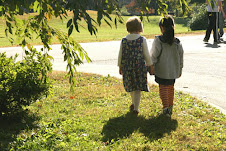
As the school year comes to an end, this coming Monday's walk-and-talk will be a celebration of another year of Sudbury-model success. I'll bring graduation theses from former Sudbury-model students, and share stories from other schools' end-of-year blog posts.
We meet for the walk-and-talk Mondays at 7:00 in front of City Hall, and begin walking at 7:15. All welcome.
Saturday, June 26, 2010

Friday, June 18, 2010
Focus
The theme of next week's walk-and-talk is a closer look at one of the strengths of the Sudbury model: Focus. Children can go days, months, years focussed on the same activity, doing what's important to them, what helps them understand their world, master their world, and eventually expand their world.
Sudbury-model schools demonstrate that if a child chooses to focus on one thing for an extended period (some kids do this, most don't), the kid learns valuable behaviours (concentration, determination, mastery) that transfer to any of life's endeavours. History also shows that these kids don't find it particularly difficult or time-consuming to round out their lives and gain skills and knowledge in areas that only become relevant to them as they grow up.
I can share stories from schools that allow this focus. The kid who fished all day for years, the kid who played video games all day for years, the kid who just played all day for years. All thrived as adults.
To get an independent view of how people do when they tackle new subjects and skills after childhood, I asked Barb Schlafer at the Ban Righ Centre about the experience of mature students at Queen's. She said that there are challenges, but that they are financial and cultural challenges, not learning challenges.
It's a myth that kids need to practice essay-writing from a young age - you can learn the skill when you need it.
Let children follow their interests, with no restrictions beyond behaviour rules. Trust that what they do has value to them, and that if they focus on one minute area of interest, the skills and self-discipline they gain will transfer into success as an adult.
Let kids focus.
Sudbury-model schools demonstrate that if a child chooses to focus on one thing for an extended period (some kids do this, most don't), the kid learns valuable behaviours (concentration, determination, mastery) that transfer to any of life's endeavours. History also shows that these kids don't find it particularly difficult or time-consuming to round out their lives and gain skills and knowledge in areas that only become relevant to them as they grow up.
I can share stories from schools that allow this focus. The kid who fished all day for years, the kid who played video games all day for years, the kid who just played all day for years. All thrived as adults.
To get an independent view of how people do when they tackle new subjects and skills after childhood, I asked Barb Schlafer at the Ban Righ Centre about the experience of mature students at Queen's. She said that there are challenges, but that they are financial and cultural challenges, not learning challenges.
It's a myth that kids need to practice essay-writing from a young age - you can learn the skill when you need it.
Let children follow their interests, with no restrictions beyond behaviour rules. Trust that what they do has value to them, and that if they focus on one minute area of interest, the skills and self-discipline they gain will transfer into success as an adult.
Let kids focus.
Tuesday, June 8, 2010
Relevance
The theme of next week's walk-and-talk is the value of relevance. Kids, like adults, come alive when they are in discussions relevant to their lives. Psychology Today brings this topic to life, so I will simply link to one of their recent blog posts.
Engaged discussion about deep themes is natural for kids. It requires only that relevance be allowed in school.
Engaged discussion about deep themes is natural for kids. It requires only that relevance be allowed in school.
Monday, May 31, 2010
Learning to Read
The theme of next Monday's walk-and-talk is a topic that highlights the success of the Sudbury model: Learning to read. Sudbury-model kids find reading to be no more challenging than many other requirements of growing up.
Reading is more than just decoding. It's also finding meaning in the words, having a relationship with the content. This is so much easier when reading begins with a child's interest - the meaning is important to them, and they already have a relationship with the content. Sudbury-model schools find that decoding an alphabet is easy compared with what kids have already accomplished: Decoding a language when they learned to talk.
Centipedes don't need to be taught how to walk. If it were attempted, you can imagine the results. Centipedes walk just fine on their own. Sudbury-model schools find the same thing to be true for kids learning to read. Kids start reading when they discover its use, when the meaning of the words is already embedded in their life.
Learning to read highlights the success of the Sudbury model.
Reading is more than just decoding. It's also finding meaning in the words, having a relationship with the content. This is so much easier when reading begins with a child's interest - the meaning is important to them, and they already have a relationship with the content. Sudbury-model schools find that decoding an alphabet is easy compared with what kids have already accomplished: Decoding a language when they learned to talk.
Centipedes don't need to be taught how to walk. If it were attempted, you can imagine the results. Centipedes walk just fine on their own. Sudbury-model schools find the same thing to be true for kids learning to read. Kids start reading when they discover its use, when the meaning of the words is already embedded in their life.
Learning to read highlights the success of the Sudbury model.
Monday, May 24, 2010
Roots of the Current Mainstream System
The theme of next Monday's walk-and-talk is a look at the roots of the current mainstream system of schooling here in Kingston. For the founding of Kingston Sudbury-model school to be recognized as worthwhile, it's helpful to understand the dynamics that lead the mainstream system to be what it is.
The current system was designed largely to assimilate immigrants, and to prepare farm children for industrial-age jobs. Egerton Ryerson, the founder of the system, was explicit about this. Trying to adapt this system to a time when we value, rather than assimilate, diverse cultures, when we are preparing children for 21st century jobs rather than for industrial-age jobs, is risky.
Adapting old forms to new purposes can work. Witness old warehouses becoming loft apartments. But it wasn't the original manufacturers who found another use for those warehouses - it took a fresh look to see the opportunity. And there also remain today tracts of ill-used warehouses, unable to be renovated because of arcane laws. Was our schooling system originally set up to effectively adapt to change?
Egerton Ryerson set up our schooling system so that power was centralized in the hands of one authority, namely Egerton Ryerson. And he, as an ardent missionary and minister, humbly believed that all of his work came under the authority of an all-powerful god. Obedience was a fundamental value, and it was built into the core of the system.
Obedience can be simply a means to an end. When I told a group of scientifically-curious 15-year-olds that they could come near an open tank of liquid nitrogen, but only if they obeyed me fully, they were happy to comply. People are equally willing to obey when it is required to hold a job. But obedience is no longer considered a fundamental value in our culture. Or perhaps I should say in our multiculture. We value navigating and supporting our differences, not forming ourselves to the will of the most powerful.
(I speak only of our civic culture. Many of us, in our religious lives, have been a part of, and continue to be a part of, communities that believe that all authority has divine origin)
One aspect of this shift towards, if I may, democracy, is that in some local mainstream schools, people are being trained to talk through interpersonal conflicts, hearing each other as equals. This includes both students and teachers. This nascent aspect of equality is in contrast to the school system's current structure, still like the original, of following a curriculum imposed from an outside authority.
Do we have today a system that has improved upon the original? Or have adjustments to the monolith created a patchwork of features that get in each other's way? That's a question for another day. Today's point is that the core features of the original system remain, features that are not only no longer relevant, but are in opposition to today's goals.
Public schools have enough challenges today - funding, politics, adapting to a diverse body of students - that are all the more challenging when trying to make use of an out-of-date structure.
Sudbury-model schools were designed after a fresh look at what was needed. Kingston needs schools designed for the 21st century.
The current system was designed largely to assimilate immigrants, and to prepare farm children for industrial-age jobs. Egerton Ryerson, the founder of the system, was explicit about this. Trying to adapt this system to a time when we value, rather than assimilate, diverse cultures, when we are preparing children for 21st century jobs rather than for industrial-age jobs, is risky.
Adapting old forms to new purposes can work. Witness old warehouses becoming loft apartments. But it wasn't the original manufacturers who found another use for those warehouses - it took a fresh look to see the opportunity. And there also remain today tracts of ill-used warehouses, unable to be renovated because of arcane laws. Was our schooling system originally set up to effectively adapt to change?
Egerton Ryerson set up our schooling system so that power was centralized in the hands of one authority, namely Egerton Ryerson. And he, as an ardent missionary and minister, humbly believed that all of his work came under the authority of an all-powerful god. Obedience was a fundamental value, and it was built into the core of the system.
Obedience can be simply a means to an end. When I told a group of scientifically-curious 15-year-olds that they could come near an open tank of liquid nitrogen, but only if they obeyed me fully, they were happy to comply. People are equally willing to obey when it is required to hold a job. But obedience is no longer considered a fundamental value in our culture. Or perhaps I should say in our multiculture. We value navigating and supporting our differences, not forming ourselves to the will of the most powerful.
(I speak only of our civic culture. Many of us, in our religious lives, have been a part of, and continue to be a part of, communities that believe that all authority has divine origin)
One aspect of this shift towards, if I may, democracy, is that in some local mainstream schools, people are being trained to talk through interpersonal conflicts, hearing each other as equals. This includes both students and teachers. This nascent aspect of equality is in contrast to the school system's current structure, still like the original, of following a curriculum imposed from an outside authority.
Do we have today a system that has improved upon the original? Or have adjustments to the monolith created a patchwork of features that get in each other's way? That's a question for another day. Today's point is that the core features of the original system remain, features that are not only no longer relevant, but are in opposition to today's goals.
Public schools have enough challenges today - funding, politics, adapting to a diverse body of students - that are all the more challenging when trying to make use of an out-of-date structure.
Sudbury-model schools were designed after a fresh look at what was needed. Kingston needs schools designed for the 21st century.
Monday, May 17, 2010
Parents in the Sudbury Model
The theme of next week's walk-and-talk is the role of parents in the Sudbury model. The theme is inspired by a brief discussion this weekend with a couple of parents who were themselves raised in a school with similarities to Sudbury schools.
Taking a broad view of human society, a main role of parents is to raise their kids from being fully dependent babies to being fully independent (or perhaps more accurately, interdependent) adults.
One challenge with this is to keep up with the astonishingly rapid development of children. After becoming habituated to providing everything to babies, parents must quickly learn new habits of care, and then new ones again, attempting to discard old behaviours as quickly as the child develops.
Focusing now on Sudbury-model families, the shift from total dependence to much independence happens early and quickly. 3-year-olds needing help can communicate their needs fairly well, and many 4-year-olds can navigate a whole school day, asking for help as necessary, able to speak up and articulate themselves when they feel they've been treated inappropriately by others.
Sudbury-model parents see their kids as able to fill their whole day with important, engaging activity. There is no need to suggest fun activities, or point out interesting things. It still happens - it's fun to share your observations and interests with your kid - but it's recognized as an act of connection, not a need for the kid's development.
For a parent, the process is a letting go. It can be scary. If I let go of my kid's hand, will she still want to walk beside me? Will he still say "watch this, watch this", or will he only think of me at mealtimes? Sudbury families tend to report that in fact joining a Sudbury school brings their family closer together. Trust, freedom and self-responsibility are a foundation for healthy and fulfilling family connection.
Parenting is a wonderful, generous act, and parents make a world of difference in the success of a Sudbury-model school.
Taking a broad view of human society, a main role of parents is to raise their kids from being fully dependent babies to being fully independent (or perhaps more accurately, interdependent) adults.
One challenge with this is to keep up with the astonishingly rapid development of children. After becoming habituated to providing everything to babies, parents must quickly learn new habits of care, and then new ones again, attempting to discard old behaviours as quickly as the child develops.
Focusing now on Sudbury-model families, the shift from total dependence to much independence happens early and quickly. 3-year-olds needing help can communicate their needs fairly well, and many 4-year-olds can navigate a whole school day, asking for help as necessary, able to speak up and articulate themselves when they feel they've been treated inappropriately by others.
Sudbury-model parents see their kids as able to fill their whole day with important, engaging activity. There is no need to suggest fun activities, or point out interesting things. It still happens - it's fun to share your observations and interests with your kid - but it's recognized as an act of connection, not a need for the kid's development.
For a parent, the process is a letting go. It can be scary. If I let go of my kid's hand, will she still want to walk beside me? Will he still say "watch this, watch this", or will he only think of me at mealtimes? Sudbury families tend to report that in fact joining a Sudbury school brings their family closer together. Trust, freedom and self-responsibility are a foundation for healthy and fulfilling family connection.
Parenting is a wonderful, generous act, and parents make a world of difference in the success of a Sudbury-model school.
Monday, May 10, 2010
The Sudbury Model Works
The theme of next Monday's walk-and-talk is another of the school's founding beliefs: That the Sudbury model demonstrably works. Here is a seed for the investigation:
Sudbury Valley School, the first Sudbury-model school, studies their graduates perhaps more than any other school in the world. Their experience is clear:
-students learned to read, and didn't find it difficult compared to other tasks of growing up
-people who wanted to go to college were able to go
-people grew up to be effective adults
-the democratically-run school has low per-student cost and excellent behaviour
One school's success could be due to any number of things: A particularly capable staff, for example, or a special environment. Many Sudbury-model schools have started up, only to close. But enough schools have succeeded, in a variety of environments, with no stand-out traits among founders other than extreme commitment, that it's worth examining the claim that it's the model itself that supports success.
I'll bring a couple of books to the walk-and-talk: The Pursuit of Happiness (Sudbury Valley's study of their graduates) and Like Water (describing the success of Fairhaven School).
Sudbury Valley School, the first Sudbury-model school, studies their graduates perhaps more than any other school in the world. Their experience is clear:
-students learned to read, and didn't find it difficult compared to other tasks of growing up
-people who wanted to go to college were able to go
-people grew up to be effective adults
-the democratically-run school has low per-student cost and excellent behaviour
One school's success could be due to any number of things: A particularly capable staff, for example, or a special environment. Many Sudbury-model schools have started up, only to close. But enough schools have succeeded, in a variety of environments, with no stand-out traits among founders other than extreme commitment, that it's worth examining the claim that it's the model itself that supports success.
I'll bring a couple of books to the walk-and-talk: The Pursuit of Happiness (Sudbury Valley's study of their graduates) and Like Water (describing the success of Fairhaven School).
Subscribe to:
Posts (Atom)